
What to Do After a Car Accident in Arizona (Step-by-Step Guide)
Not sure what to do after a car accident in Arizona? This step-by-step guide explains how to protect your health, preserve evidence, deal with insurance companies, and protect your legal rights after a crash.
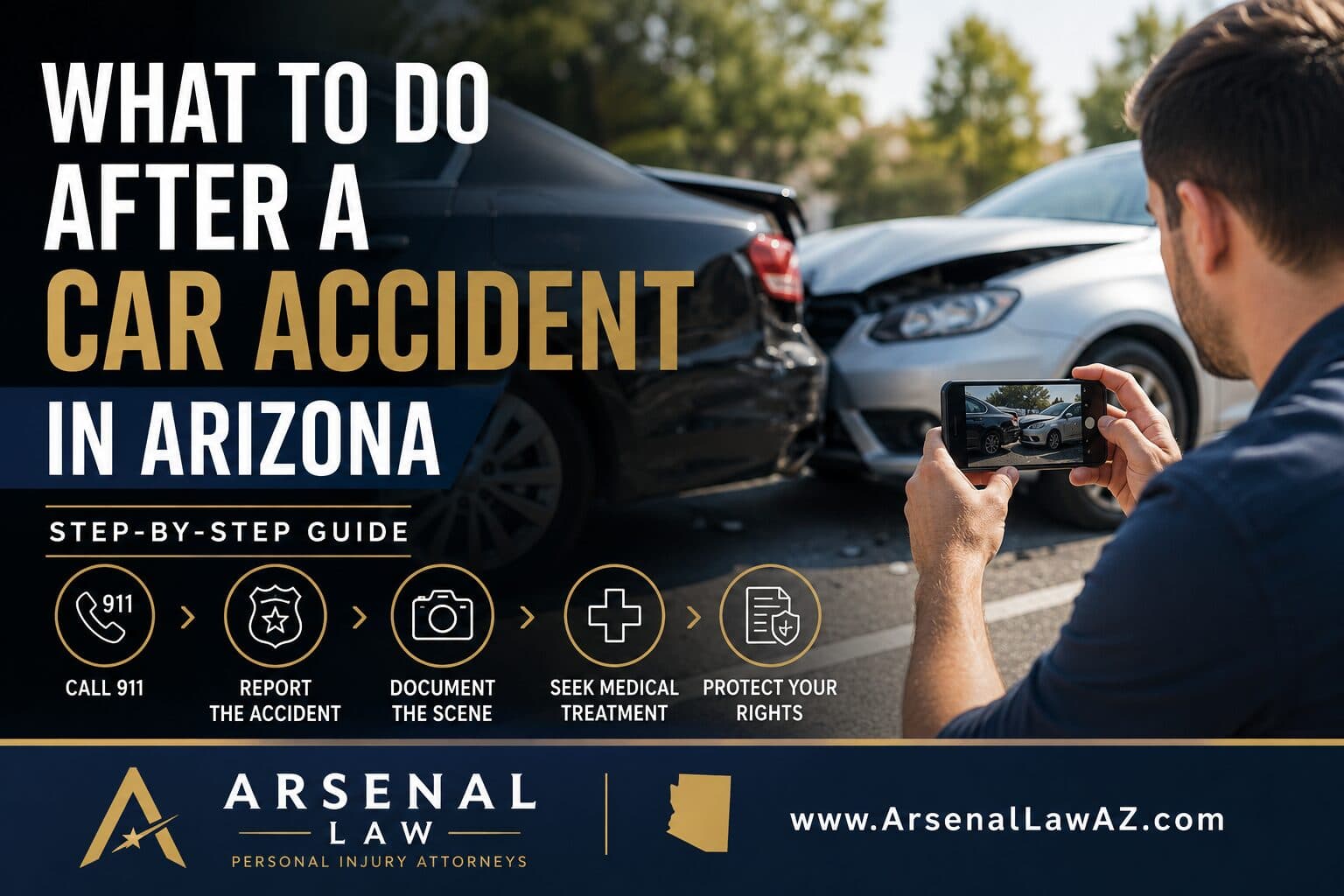
A Step-by-Step Guide for Arizona Drivers
A car accident can happen in a matter of seconds, but the decisions you make afterward can affect your health, finances, and legal rights for months or even years. Whether you are involved in a minor fender bender or a serious collision, knowing what to do after a car accident in Arizona can help protect both your well-being and your potential injury claim.
This guide walks through the important steps Arizona drivers should take after an accident.
Step 1: Check for Injuries and Call 911
Your first priority should always be safety.
Check yourself and your passengers for injuries. If anyone is injured, call 911 immediately and request emergency medical assistance. Even if injuries appear minor, it is often wise to have medical professionals evaluate everyone involved.
If the vehicles can be moved safely, Arizona law generally encourages drivers to move vehicles out of traffic to reduce the risk of additional collisions.
Never leave the scene of an accident before exchanging information and fulfilling your legal obligations.
Step 2: Contact Law Enforcement
Many people wonder whether they need a police report after an accident.
While not every accident requires extensive police involvement, having law enforcement respond can provide important documentation regarding:
- The date and time of the collision
- The parties involved
- Witness information
- Vehicle damage
- Road conditions
- Statements made at the scene
A police report can become valuable evidence later if there is a dispute regarding fault or injuries.
Step 3: Exchange Information with the Other Driver
Arizona drivers should exchange:
- Full name
- Address
- Phone number
- Driver's license information
- Insurance company
- Insurance policy number
- Vehicle registration information
Remain calm and courteous during this process.
Avoid arguing about who caused the accident.
Step 4: Document the Scene
Your smartphone can become one of the most important tools after an accident.
Take photographs of:
- Vehicle damage
- License plates
- Skid marks
- Debris
- Traffic signs
- Road conditions
- Visible injuries
- The overall accident scene
The more documentation you have, the easier it may be to establish what occurred.
If there are witnesses, ask for their names and contact information.
Step 5: Do Not Admit Fault
Many people instinctively apologize after an accident, even when they are not at fault.
Statements such as:
- "I'm sorry."
- "I didn't see you."
- "This was my fault."
can later be interpreted as admissions of liability.
Instead, focus on exchanging information and cooperating with law enforcement.
The investigation should determine who was responsible.
Step 6: Seek Medical Treatment Immediately
One of the biggest mistakes accident victims make is delaying medical treatment.
Some injuries may not become apparent until hours or days after a crash, including:
- Whiplash
- Concussions
- Back injuries
- Soft tissue injuries
- Internal injuries
Prompt medical treatment helps:
- Protect your health
- Create documentation of your injuries
- Establish a connection between the accident and your medical condition
Insurance companies often argue that delayed treatment means an injury was not serious or was caused by something else.
Step 7: Notify Your Insurance Company
Most insurance policies require prompt notice of an accident.
When reporting the collision:
- Provide basic facts
- Be truthful
- Avoid speculation
- Do not exaggerate injuries
If the other driver's insurance company contacts you, proceed carefully.
You are generally not required to provide a recorded statement immediately, and it may be wise to speak with an attorney before doing so.
Step 8: Keep Records of Everything
Create a file containing:
- Police reports
- Medical records
- Medical bills
- Prescription receipts
- Vehicle repair estimates
- Rental car expenses
- Photographs
- Insurance correspondence
These records can help establish the full extent of your damages.
Step 9: Follow Your Doctor's Recommendations
Insurance companies frequently review whether accident victims followed medical advice.
Missing appointments, stopping treatment early, or failing to follow medical recommendations can create challenges when pursuing compensation.
Attend follow-up appointments and follow your treatment plan whenever possible.
Step 10: Understand Arizona's Comparative Negligence Rules
Arizona follows a system known as pure comparative negligence.
This means that even if you were partially responsible for an accident, you may still recover compensation.
For example:
- If your damages are $100,000
- And you are found 20% at fault
You may still recover $80,000.
Because fault can significantly affect compensation, proper investigation and evidence gathering are important.
Step 11: Be Careful with Early Settlement Offers
Insurance companies sometimes make quick settlement offers shortly after an accident.
While receiving money quickly may seem appealing, early offers often occur before:
- Medical treatment is complete
- Future medical needs are known
- Lost wages are fully calculated
- Long-term effects are understood
Once a settlement is accepted, additional compensation is often unavailable.
It is important to understand the full value of your claim before agreeing to settle.
Step 12: Speak with a Personal Injury Attorney if Necessary
Not every accident requires legal representation.
However, it may be beneficial to consult an attorney if:
- You suffered significant injuries
- Liability is disputed
- The insurance company denies responsibility
- Multiple vehicles were involved
- A commercial vehicle was involved
- The insurer makes an inadequate settlement offer
An attorney can help evaluate your claim and explain your options.
Common Mistakes to Avoid After an Arizona Car Accident
Avoid these common errors:
❌ Leaving the scene too quickly
❌ Failing to call law enforcement
❌ Delaying medical treatment
❌ Admitting fault
❌ Giving recorded statements without understanding your rights
❌ Accepting a quick settlement offer
❌ Posting details about the accident on social media
Even seemingly harmless social media posts can be used by insurance companies during a claim.
Final Thoughts
A car accident can be overwhelming, but taking the right steps immediately afterward can make a significant difference. Protect your health, document the scene, seek medical treatment, and preserve evidence whenever possible.
Understanding what to do after a car accident in Arizona can help protect both your recovery and your legal rights.
If you have questions about an Arizona car accident injury claim, Arsenal Law can help you understand your options and evaluate your case.
Schedule a Consultation
To schedule an initial consultation with Arsenal Law, visit: